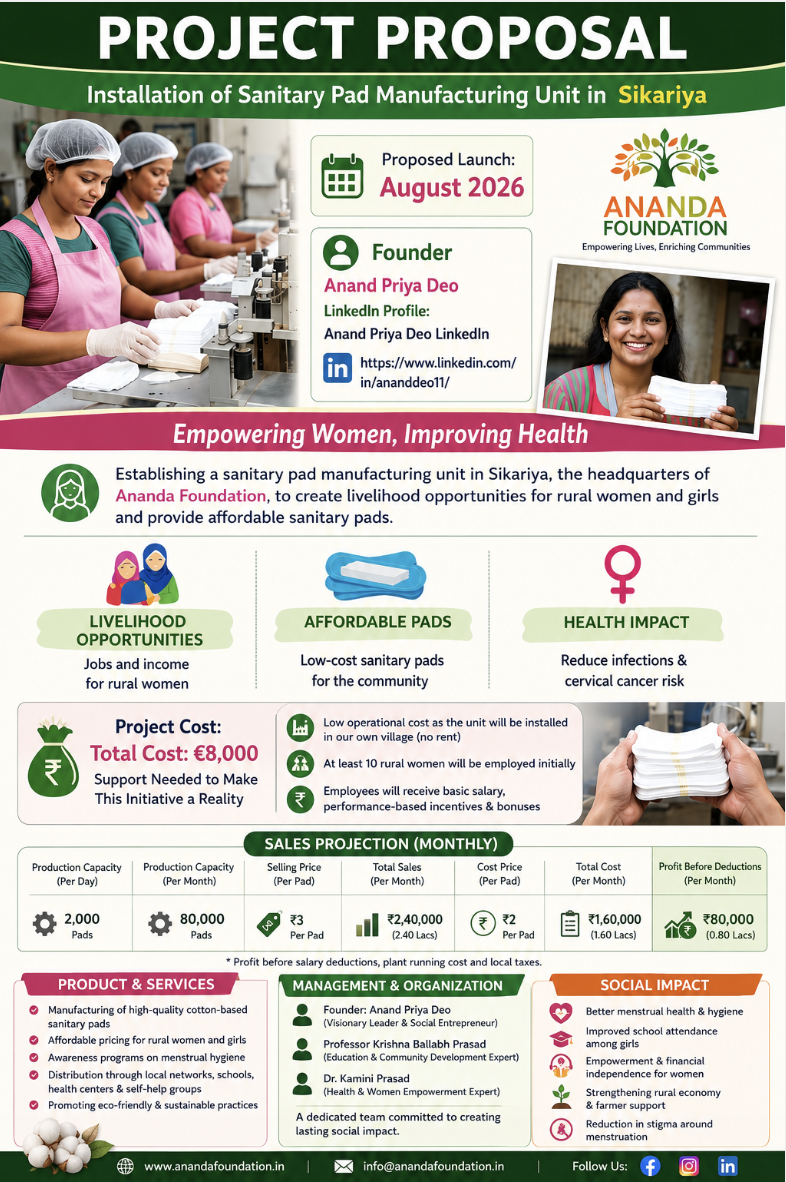
In Sikariya and across rural Bihar, sanitary pads remain unaffordable and inaccessible for most women and girls. Market price is ₹8+ per pad — out of reach for daily agricultural labourers earning ₹200–300 per day. The result: women resort to cloth, ash, and other unsafe alternatives. Health consequences are serious and preventable.
Ananda Foundation is establishing a sanitary pad manufacturing unit in Sikariya — the organisation's own village — to change this. The unit will produce high-quality, cotton-based sanitary pads at ₹3 per pad — well below the market rate. And it will employ at least 10 rural women from day one, paying basic salary plus performance-based incentives.
This is not charity. It is a sustainable enterprise — one that will eventually sustain itself and generate surplus income for the foundation's other programs.
Girls in rural Bihar miss 3–5 school days per month during menstruation. Not because of pain — but because they have no safe, affordable sanitary products. At ₹3/pad vs ₹8+ in shops, the Ananda unit makes the difference between attending and staying home.
Agricultural work is seasonal, back-breaking and controlled by men. The pad unit offers 10+ women stable, year-round employment with a basic salary and performance incentives — in their own village, close to their families, with dignity.
Ananda Foundation does not want to rely on donations forever. The pad unit will generate ₹80,000/month gross profit within its first year of full operation — a revenue stream that helps fund the foundation's other programs long-term.
Conservative projections based on local market research. The unit will install in our own village — zero rent, minimal overhead.
| Parameter | Per Day | Per Month | Value |
|---|---|---|---|
| Production Capacity | 2,000 pads | 80,000 pads | Full capacity |
| Selling Price | — | — | ₹3 per pad |
| Total Sales Revenue | ₹6,000 | ₹2,40,000 | ₹2.40 Lacs/month |
| Cost Price | — | — | ₹2 per pad |
| Total Production Cost | ₹4,000 | ₹1,60,000 | ₹1.60 Lacs/month |
| Gross Profit | ₹2,000 | ₹80,000 | ₹0.80 Lacs/month |
* Profit before salary deductions, plant running costs and local taxes. Final net profit will depend on operational costs during ramp-up phase.
Every euro is accounted for. Here is the breakdown of how the funds will be used to get the unit operational.
Core pad-making machinery — pad forming unit, heat sealing equipment, and quality testing tools sourced from certified Indian manufacturers.
Initial stock of cotton, absorbent core material, packaging film and back-sheet. Sufficient for the first 2–3 months of production.
Training the 10 initial women employees — machine operation, quality control, hygiene standards, basic bookkeeping and workplace safety.
Minor infrastructure work to prepare the production space — electrical fittings, ventilation, shelving and storage within our own village property.
Initial distribution network setup — school outreach, self-help group partnerships, health centre connections across Nawada district.
A small operational buffer to handle unexpected costs during the ramp-up phase — typically machine repairs or material price fluctuations.
2023–24 · Need confirmed
2025–26 · €10,000 target
Jun–Jul 2026 · Installation
August 2026 · First pads
Every €100 brings us closer to the first pad rolling off the production line — made by a woman in Sikariya, for a girl in a school in Nawada.
For bank transfer or large donation enquiries, write to anandafoundation1@gmail.com